Most Teardrop campers have some sort of power system. It could be as simple as a portable self-contained battery-inverter-charger, or could be a fully-equipped solar system hard-wired into the trailer.
My house is completely off-grid (95% solar power + 5% generator supplement in the dark months) and my Teardrop has more-or-less a scaled-down version of my home system, except instead of a generator as the alternate power source the trailer accepts an external electrical hookup.
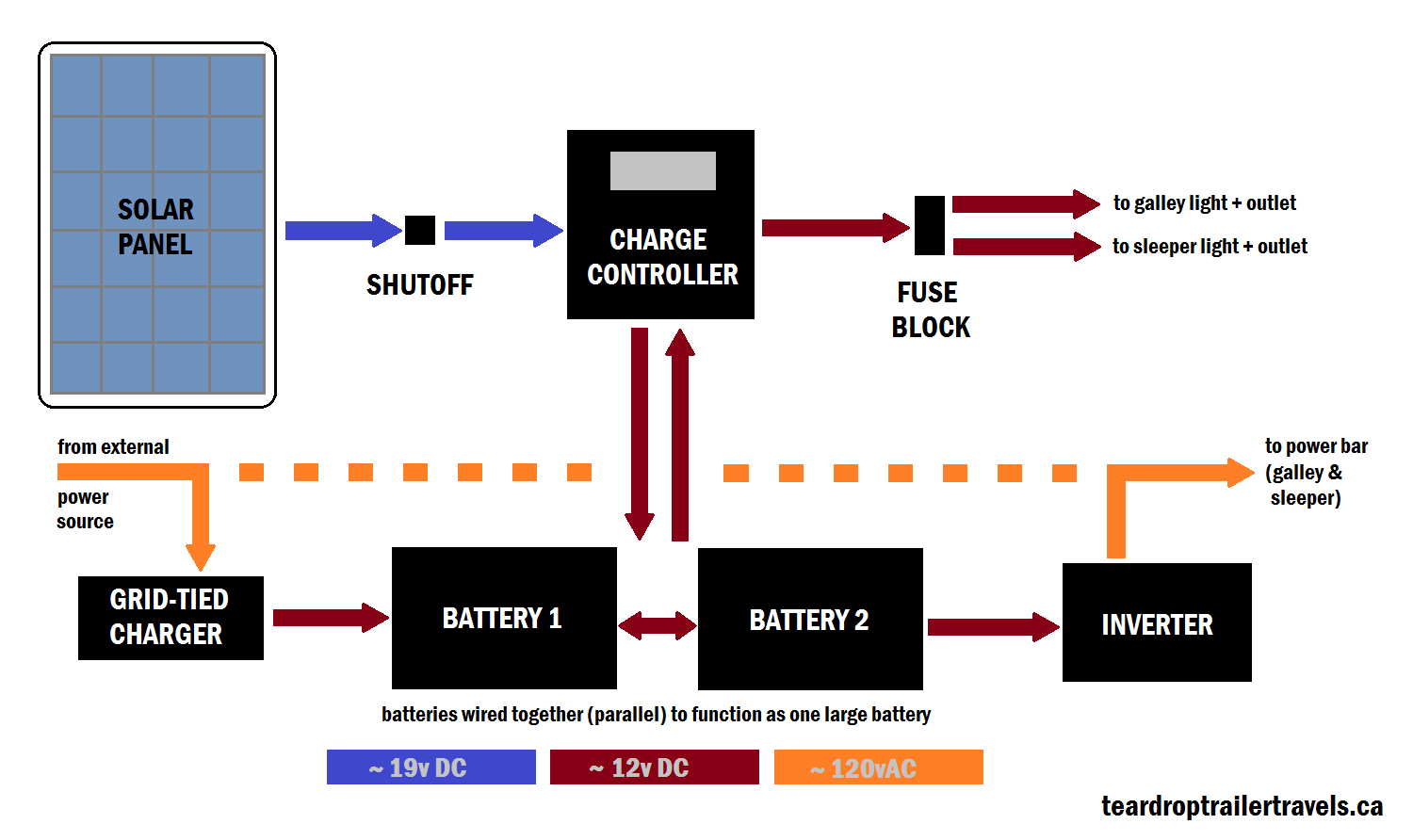
Trailer Electrical System Components
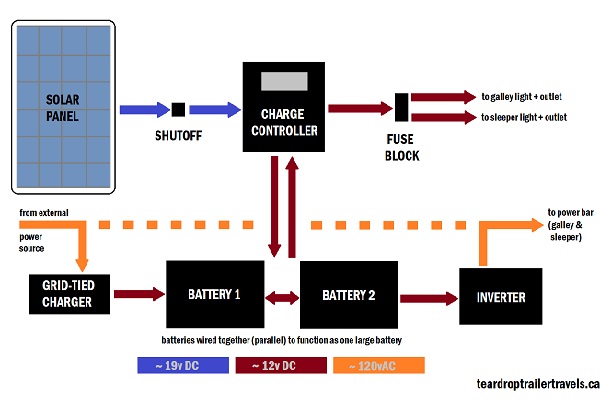
The power system in my camper is generally representative of the setup in most hard-wired Teardrop trailer electrical systems. Essentially, it is an on-board, off-grid renewable energy system which has 4 main elements:
- Power Source – This could be generated on-site (solar panel or petroleum-fueled generator) or grid-tie (e.g., campground electrical hookup).
- Storage – You need to be able to store the electricity in batteries if you wish to consume it even when there is no power source.
- Conversion – Electricity stored in batteries is direct current (DC), usually 12 volts like in your car. This is fine for things which run on 12VDC but anything else will require a transformer/adapter (for different DC voltage) or an inverter (for 120VAC “house current”).
- Distribution – Wiring and outlets are a convenient way to move and access the electricity from batteries or inverter rather than connecting directly to them at the source.
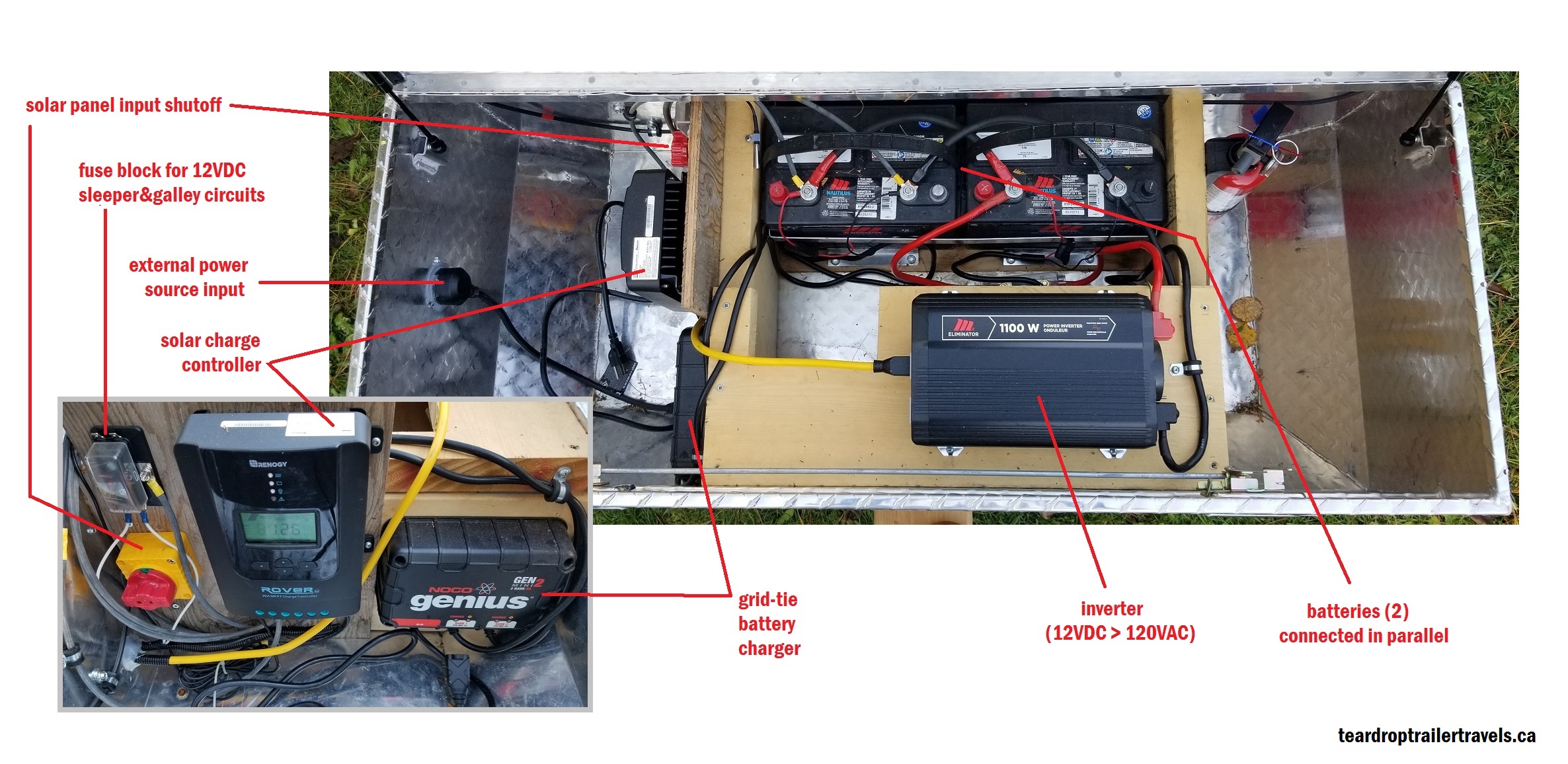
The kinds of things my system powers include interior lights, a mini-kettle, small rice cooker, several USB-powered devices, an electric cooler, and even a personal heater to take the edge off cool nights. I’ve also heard of Teardrop trailers with microwaves, toasters and mini-blenders!
Once you have read this overview, check out my Electrical Systems Essentials blogs covering batteries, solar panel & charge controller, and inverters. For each of these components, I have tried to boil it down to what a Teardropper most needs to know.
So, that’s how I do things with my Teardrop Trailer but by no means the full story or the best way. What about you? Add your own methods, ideas and experiences using the comment box below for the benefit of all readers.
 Teardrop Trailer Travels