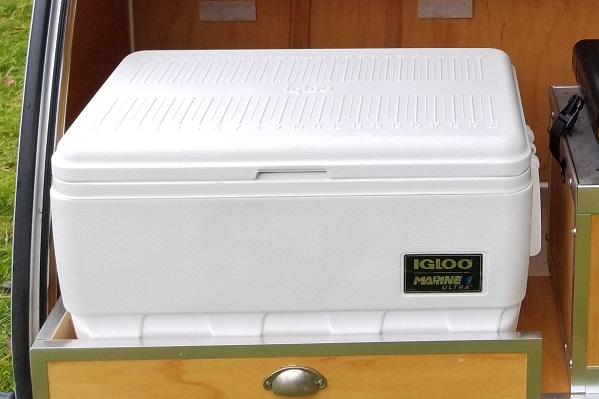
Seems like it should be a straightforward topic but coolers—where you store your perishable foods while Teardrop camping—come in a variety of types, shapes and size, all factors which will be important to consider along with your intended use and placement of your Teardrop trailer cooler.
Passive coolers keep their contents cold by retaining the coolness from ice or gel-packs you place inside. Powered coolers refrigerate on their own without ice; they plug into an automotive power socket (12VDC) and sometimes also have a 120VAC power supply for house current.
Passive Coolers (aka Ice Chests)
At the upper end (of price and keep-cool performance) are latched, airtight coolers, with multiple inches of insulation, and usually manufactured by a process called rotomolding. They have less capacity relative to the external size of the cooler because of their thick walls and lids.
At the lower end are hundreds of different standard chest coolers, typically with an inch or less of insulation, and usually with a lid that snaps shut without an airtight seal. There’s not much of a middle ground between upper and lower ends though some non-airtight coolers profess to include better or unique formulations of insulation.
There are also “marine” coolers which generally means they have more UV protection in the plastic and/or are strong enough to be used as a seat. Oh, and they have an inch/cm ruler on top for measuring fish 😉


Powered Coolers
There are two main types: thermoelectric and compressor. There is all kinds of detail you can research but the essential differences are:
- Cost: comparing equal capacity sizes, thermoelectric will be cheaper than compressor coolers, which may be double or more the cost.
- Size: comparing equal capacity sizes, thermoelectric will be moderately less bulky because compressor coolers have more mechanical equipment to fit into the package.
- Power Consumption: comparing similar capacity sizes, thermoelectric will generally have a lower wattage than compressor coolers… but remember it’s not about wattage so much as it is about watt-hours consumed to accomplish a given cooling task.
- Cooling Power: thermoelectric coolers are typically rated to be able to cool a certain number of degrees below whatever ambient temperature surrounds the cooler, while compressor coolers have a defined cooling range which will often (at least in better quality units) extend into below-freezing temperatures.
Summary version, and this is generalizing: a thermoelectric cooler will do a job similar to a passive cooler just without the need for ice, while a compressor cooler is more akin to a small refrigerator, can maintain a more precise temperature range, and in many cases is actually capable of freezing its contents. (Though that may take quite some time for a small compressor cooler to accomplish. Freezing contents is an impossible task for a thermoelectric cooler.)
Chest Cooler Size
Size will be a defining factor in cooler choice if you wish to keep it in the Teardrop trailer kitchen. I have one of each type of passive cooler (i.e., a high-end airtight, and a standard) and I chose them as much based on what was the largest capacity I could find that fit into the cooler pull-out in my galley as I did based on performance reviews.
The only reason I chose a marine type standard cooler was because it was slightly larger and I wanted to max out the available space in the cooler pullout. Unless you have good spatial aptitude, and are 100% confident in the dimensions provided by whoever is manufacturing your Teardrop, I would wait until you actually have the trailer in front of you to measure before investing in a cooler.


Cooler Functionality
Most coolers have some sort of benchmark (e.g., keeps ice frozen for 3 days) for passive coolers or a temperature range for powered coolers. In either case these are under ideal conditions and unlikely to be experienced in real-life use, particularly when it comes to some of the “keeps ice frozen for ? days” statements.
I have 3 coolers for use with my Teardrop camper. The cooler, or combination of coolers, I take on a road trip depends on the length of the trip and the expected temperature conditions.
I prefer not to be dependent on finding ice during road trips, and I have 2 batteries in my on-board electrical system, so my general strategy is to have two gel-packs in a passive cooler with my food while the smallish compressor cooler is used to refreeze two other gel-packs. When I am on the move, the compressor cooler gets plugged into the car; when I am stationary it is plugged into the trailer’s 12VDC system.
Hints & Hacks
- Remember that warmer air rises, cooler air sinks, so pack what needs to be most cool at the bottom of a cooler.
- Because a bag of ice cubes have much more surface area than an ice block of the same weight, cubes will thaw much faster; an ice block will provide better value and more longevity for keeping your cooler cold.
- Ice cubes, however, are more effective than a block when you need to get something cooled down—both because of all the surface area as well as the ice-cold water they produce as they thaw.
- Pre-chill your passive cooler at home before heading off on a road trip to save the ice or gel-packs a bit of cooling work and they will last slightly longer.
- Consider what foods can be frozen (e.g., soups, stews, etc.) ahead of time and used like freezer packs to help keep the cooler cold.
- When buying a 12VDC cooler, look for one that also includes an AC adapter. This way anytime you have a campground hookup or access to house current, you can run the cooler from that rather than your battery.
- I do not think it advisable to transport a powered cooler (particularly if in operation) in the Teardrop trailer galley. Most trailers have a simple leaf spring suspension so things get shaken around while on the move.
So, that’s how I do things with my Teardrop Trailer but by no means the full story or the best way. What about you? Add your own methods, ideas and experiences using the comment box below for the benefit of all readers.
 Teardrop Trailer Travels
I have an Alpicool compressor fridge. It is about 35 qts and it works very well. I first bought a much larger Dometic compressor fridge ( about $1,000) and I like the Alpicool better and it was only about $300. It is efficient and quiet. I use a dedicated 35 Ah battery to operate it or 12v from the car when we are driving.
LikeLike