
This is a broad topic, and having both a solar-powered Teardrop trailer and an off-grid solar-powered house there’s a lot I can say about it. This began as a large article which then got whittled down to what is most essential for a Teardropper to know when choosing batteries and to be aware of in their day-to-day use. For context, it might be useful to review the electrical system overview to see how the components all fit together.
First, a few useful terms
Voltage – A battery has a voltage based on the number of cells it contains (don’t worry about the how/why). In most cases the batteries used in a Teardrop trailer electrical system will be 12 volts, just like in your vehicle. Calling it 12 volts is the “nominal voltage”; the actual voltage will vary with the battery’s state-of-charge as well as how much power happens to be leaving (or being put in, if charging) at any given time.
Amps – Using a river as an analogy, volts is said to be the speed (i.e., pressure) the water is flowing while amps is how wide the river is (i.e., the volume that is flowing).
Watts – A measure of power consumption at any given time. Watts are a simple matter of multiplying volts x amps. If the USB charger I plug into what used to be called a cigarette lighter socket draws 3 amps, and we know the system voltage is 12, then it is using 3×12=36 watts… at least according to its rated input, actual may vary slightly.
Watt-Hours – A measure of total power consumed to accomplish a given task. If my mini-kettle draws 400 watts and takes 4 minutes to boil water then it uses (4/60)x400=27 watt-Hours to accomplish that task, the equivalent of using 27 watts for one hour. To determine kilowatt-Hours divide watt-Hours by 1000.
Amp-Hours – Same idea as watt-Hours, but with amps, though amp-Hours are more commonly used as an indication of total capacity than power consumed. Any battery has an amp-Hours rating, which would be the total amount of power “in the bank” so to speak which can be withdrawn before it is fully depleted. (More on this below.)

What to Know When Choosing a Teardrop Trailer Battery
Most essential is to know: (a) battery type, so that it matches your intended use, (b) battery capacity (amp-Hours), so that it will store enough power for your needs, and (c) battery chemistry, which affects safety, charging profile and useful lifetime.
Battery Types (functions)
Basically, there are cranking batteries and deep cycle batteries. (There are also batteries designed to do both tasks, though of course that means peak performance on neither.)
A cranking battery, like what is in your car, is designed to provide a lot of amps for a short period (e.g., to turn the starter on an engine) and then be topped-up sometime soon. Cranking batteries are not designed to be deeply discharged. You may have learned this the hard way if you’ve left your car headlights, or some other accessory, turned on multiple times. After several full discharges, battery capability becomes severely compromised.
A deep cycle battery is designed to service moderate amps discharge spread over longer periods between recharging, so deeper discharge but with less degradation to the battery’s capability. However there is nevertheless a correlation between how deeply the battery gets discharged and how many recharge cycles you get in its useful lifetime.
Battery Design (chemistry)
The two most common for this application, since on-board trailer electrical systems require larger capacity batteries, are lead acid and lithium.
Most lead acid batteries of the size used in trailer applications are now “maintenance free” and do not require periodic checking of acid level and top-up with distilled water. However, they are not necessarily fully “sealed” and may ventilate small amounts of gas while charging. There are also AGM (absorbed glass mat) and gel lead acid batteries, which are usually sealed and valve regulated. The voltage of all lead acid battery types declines gradually as they become discharged.
Lithium batteries are more recent technology than lead acid. They are fully “dry” batteries (containing no fluid or gel), resilient to deep discharge, and have more capacity compared to a lead acid battery of similar dimensions. They also weigh less than a comparable amp-hour lead acid battery. Lithium batteries have the useful characteristic of holding their voltage fairly stable until getting close to fully discharged.
Battery Capacity (amp-Hours)

Each battery, regardless of type or chemistry, will have an amp-Hours rating. For instance each of the two deep-cycle batteries in my Teardrop camper utility box are 75 amp-Hours. Remember that watts = volts x amps? So, then, each battery has 75×12=900 watt-Hours and since I have two of them, I have 1800 watt-Hours in storage.
Oh boy, all sorts of things I could do with that power…. I could run a 900 watt microwave for two hours straight. Or a 600 watt heater for 3 hours. Well, not quite folks, cuz that capacity rating is theoretical, and based on the battery being brand-new, completely charged, and used in ideal conditions. What’s more, to completely discharge a lead-acid battery until it can’t give any more is not a good idea, regardless of type even if it’s deep cycle. Hmm, just as well I don’t have a microwave in the galley.
As a general rule, with a conservative safety buffer to account for real-world conditions as well as battery aging, I consider somewhere between one-half and two-thirds of the rated capacity to be the actual usable capacity I would have to work with. So that leaves me with between 900 and 1200 watt-Hours (0.9 – 1.2 kilowatt-Hours) I can count on, which is still more than I am likely to need… unless I did want to run that little interior heater a lot on a cold autumn night 😉
So, sizing up what an-hour capacity you need will require some estimate of power consumption between charges to ensure the battery can service it without discharging too low.
So, what is best battery option for a Teardrop electrical system?
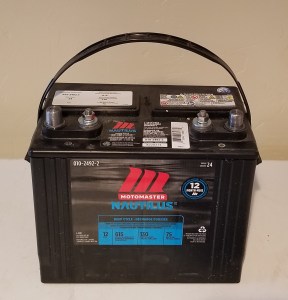
Easy answer. The best option is lithium. BUT they are expensive AND you need to have a charge controller (for solar panels) or charger (for grid hookup) that has a lithium setting because they have a charging profile different from lead-acid. But if you can afford it, go for it.
Mainly due to cost, I would guess that most Teardrop trailers have lead-acid batteries. And with them there are more variations, and each has its own cost, convenience and safety factor. My suggestions:
- Use deep-cycle. It just makes sense, match the battery to the task. You could use a cranking or combo battery, but you’ll be replacing it much sooner.
- Use marine, not automotive, batteries. They are a bit more expensive but more ruggedly built inside (thicker lead plates) and out (housing). Your trailer suspension is less finessed than your car’s and things get bounced around back there.
- For better safety, choose a sealed, valve-regulated battery like AGM or gel, though it will be 1.5 to 2 times the cost of a regular “no maintenance” lead-acid battery. If the battery location has some ventilation it may not be as high a priority.
- Look for the highest amp-Hours available in the battery size which fits your trailer. It won’t make an enormous cost difference and it’s always better to have excess capacity than not enough.
What to be Aware of During Battery Use
Just like checking the fuel gauge in your car, knowing your battery’s state-of-charge is important. Like with a gas tank, being aware of the level makes it less likely you will run out. Also, with lead-acid batteries the less they are run down between charges, the more recharge cycles they will have in their useful lifetime.
Assessing State of Charge
State-of-charge is generally indicated by the battery voltage. BUT a battery’s true voltage can only be known when it has settled in a state of rest (i.e., nothing drawing power out, and no charging in) which is never going to happen unless you flip the master disconnect switch and wait an hour.
But that’s okay, we really don’t need exactitude, you can still get a pretty good estimation. The best time is when you have not been drawing much power for the past hour… no appliances, devices, chargers, etc, perhaps just a little LED light sipping a few watts… and when it is dark outside so no charging from the solar panels. In those kind of conditions, the displayed voltage will probably be within 0.1 or 0.2 volts of the true battery voltage.

How does Voltage correlate with State of Charge?
Well, that will vary with each battery depending on the type and chemistry. You can find state-of-charge charts online… I created this one as a summary version and rounded the voltages to one decimal since that is probably all you will see on your trailer’s electrical system voltage display. More accurate would be to consult your battery manufacturer.
When looking at whatever device displays your battery voltage, keep in mind that you will often see voltages in the 13 and 14 range while it is charging. And that voltage may appear significantly lower during high-wattage draw (like my heater or mini-kettle) but the voltage will rebound somewhat once the draw has stopped.
Also keep in mind that your display may not be accurate! Find a geeky friend with a quality multi-meter and get a rating directly off the battery to compare with the displayed voltage so you can make a mental adjustment when you look at it.
One further wrinkle to this whole state-of-charge thing is that battery voltage will vary with battery temperature. Most battery ratings are based on 21°C (70°F). As a general approximation, with each drop of 5°C below 21°C, expect voltage values drop about 0.1, and the opposite for each 5°C above 21. But don’t get too tied up on all that, I just threw it in for the techie Teardroppers.
The bottom line is do your best to manage power use so that state-of-charge mostly remains in the top 50% and never gets to the bottom 20% and you will get decent useful life from your deep cycle battery. And don’t panic if it temporarily zips down into the 11 volt range while you are using something that draws a few hundred watts. Voltage will rebound somewhat once the power draw has stopped.
So, that’s how I do things with my Teardrop Trailer but by no means the full story or the best way. What about you? Add your own methods, ideas and experiences using the comment box below for the benefit of all readers.
 Teardrop Trailer Travels