
There are two types of electricity available in my solar-powered Teardrop trailer: 12VDC (direct from battery) and 120VAC aka “house current” (via an inverter, which draws from the battery). The 12V service tends to get used for low power consumption loads while the 120V powers things like the rice cooker, mini-kettle or even a personal heater on cool nights.

A lot of what consumes electricity in the sleeper cabin tends to be small devices, most of them USB-powered. I wanted a simple way to have these draw directly from the battery rather than plug USB chargers into the 120V since efficiency is lost during the inversion process that changes 12V battery power into 120V house current.
12V outlets + USB Charging Hub
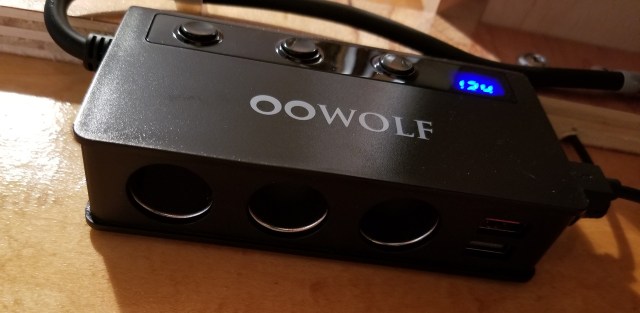
A device like this is helpful for distributing the power safely and with minimal wire clutter. A similar idea to a power bar, it plugs into one 12V outlet (what was once known as a cigarette lighter socket) and splits it into several power sources. In this case, it provides three 12V outlets (each with its own on/off switch) and four USB outlets, but there are many configurations of such power distribution devices to be found.
A bonus feature to look for is having a voltage readout so you can monitor the condition of the batteries from inside the sleeper cabin.
Hints & Hacks
- Compare the device’s displayed voltage with that from a quality multi-meter to determine true battery voltage. For instance, I know mine reads 0.3-0.2 volts less than true battery voltage so I mentally account for that when looking at the display.
- Keep in mind that when there is no incoming charge, battery voltage will display lower while under load (i.e., something is consuming electricity, especially if several hundred watts) then rebound somewhat once the load ceases or lessens.
- These products usually come with double-sided adhesive mounting strips, but maybe not the best of them. All it took was a bumpy road to set mine free from the wall. Some Gorilla brand mounting tape seems to have solved that once and for all.
So, that’s how I do things with my Teardrop Trailer but by no means the full story or the best way. What about you? Add your own methods, ideas and experiences using the comment box below for the benefit of all readers.
 Teardrop Trailer Travels