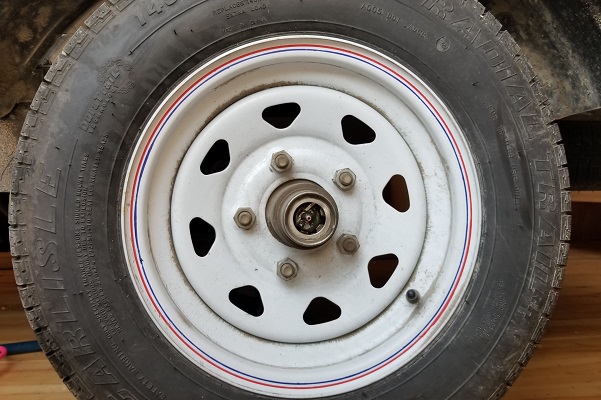
Last year’s tire blowout had me paying more attention to what is between my teardrop trailer frame and the road. First I journeyed down the tires rabbit hole looking for a better option than the supplied OEM. Then I set sights on maintenance of the hubs and bearings which allow the wheels to spin freely and found perhaps more opinion than fact. Here’s my best attempt to sort out what is dependable vs questionable.
The assembly which allows your trailer to roll on down the highway is a pretty simple affair on most small teardrops. Typically there is a straight axle mounted either on top of leaf springs (“underslung”) or below them (“overslung”), and at each end of the axle an “idler” hub (i.e., no brakes) onto which the wheel is bolted. It’s essentially the same or very similar to a small boat or utility trailer.

Inside each hub are two sets of bearings (inner and outer) which allow the attached wheel to rotate freely around the axle. In most hubs these are not the little balls which come to mind when imagining bearings but more like slightly angled cylinders which roll in place. Bearings need grease to roll or else they’d wear down pretty quickly, and get mighty hot from all the friction.
Though there is a dust plug (typically rubber) in between the outer world and the inner workings of the hub and its bearings, it’s not a perfect seal and inevitably over time some degree of road dust and dirt (and even moisture, especially if the dust plug or end cap is damaged) will make its way in and begin to contaminate the grease—particularly if you drive a lot on gravel roads.
Grease Type for Trailer Bearings
Given this imperfect seal, bearing grease must be renewed periodically. Before we get to the more arguable matters of when and how to do this, let’s deal with an easier question: what type of grease?
Don’t use general purpose grease for trailer bearings! Those little wheels on your beloved Teardrop camper turn at a very high speed (consider that if your trailer has 12” wheels and your tow vehicle 17”, the ones on the trailer will revolve about 1.4 times more, and hence faster, over the same distance) and the grease must be formulated to maintain lubricity and not degrade under those conditions.
Personally, I use “extreme” grease intended for bearings and other high-temperature applications… it is tinted red to identify it as such… which has excellent mechanical stability and good water resistance. Some might say it’s overkill for a light trailer but we’re talking about the difference of just a few dollars per grease cartridge.
When to Grease Trailer Bearings
The service interval for trailer hubs & their bearings is going to depend on a several variables, the main ones being:
- Distance Travelled (keep track by using a trailer journal or log)
- Wheel Size (smaller wheel = more revolutions per kilometre)
- Road surface (e.g., gravel, dirt, or sandy/dusty conditions)
- Exposure to moisture (e.g., sustained and repeated use in significant rain)
A cautious service interval would be every 10-15,000km (dependent on the variable factors), or at least every two years, this according to the guy at my local trailer place and generally supported by the variety of recommendations found online.
In-between servicing, there are also some ways to monitor bearing health, much in the same way we routinely check tire pressure or engine oil level. Before a major road trip, I will jack up the trailer axle and spin each wheel. It should appear to rotate evenly and smoothly, and there should be no sounds like grating or grinding. While on the road, whenever I make a stop to take a break I carefully touch the wheel hubs. Slightly warm is not a worry, but if they feel hot to the touch something is likely unwell inside.

Fresh Grease = Happy Wheel Bearings
We’ve covered what type of grease for bearings, and how often to service them, but what should that service entail? If you’ve come to this blog post looking for how-to instructions, sorry this isn’t it, but don’t worry there’s no shortage of advice and techniques to be found elsewhere online. But maybe you should worry: not all that advice is necessarily competent, and not all those techniques are necessarily advisable. Here’s what I learned, some of it the hard way.
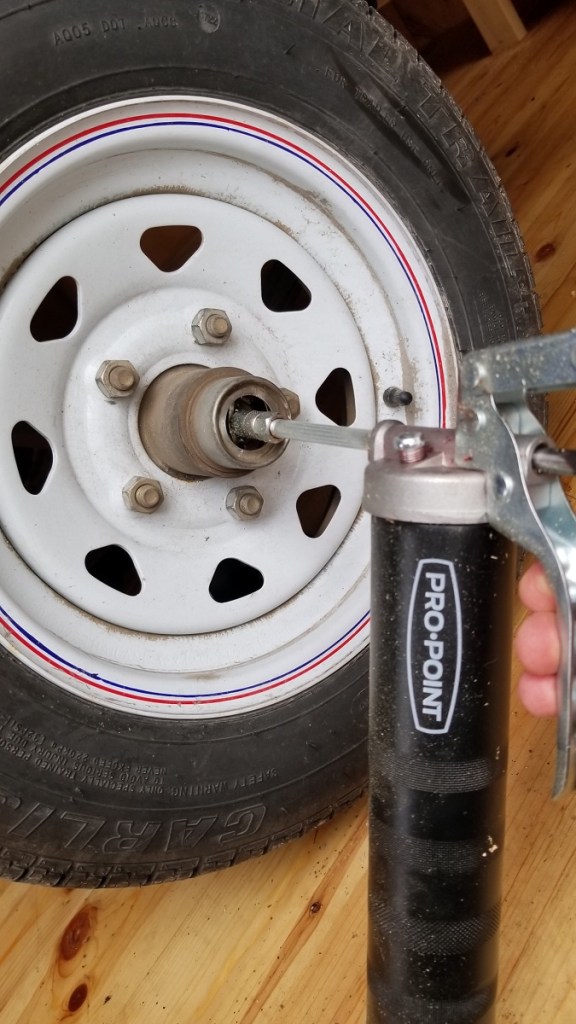
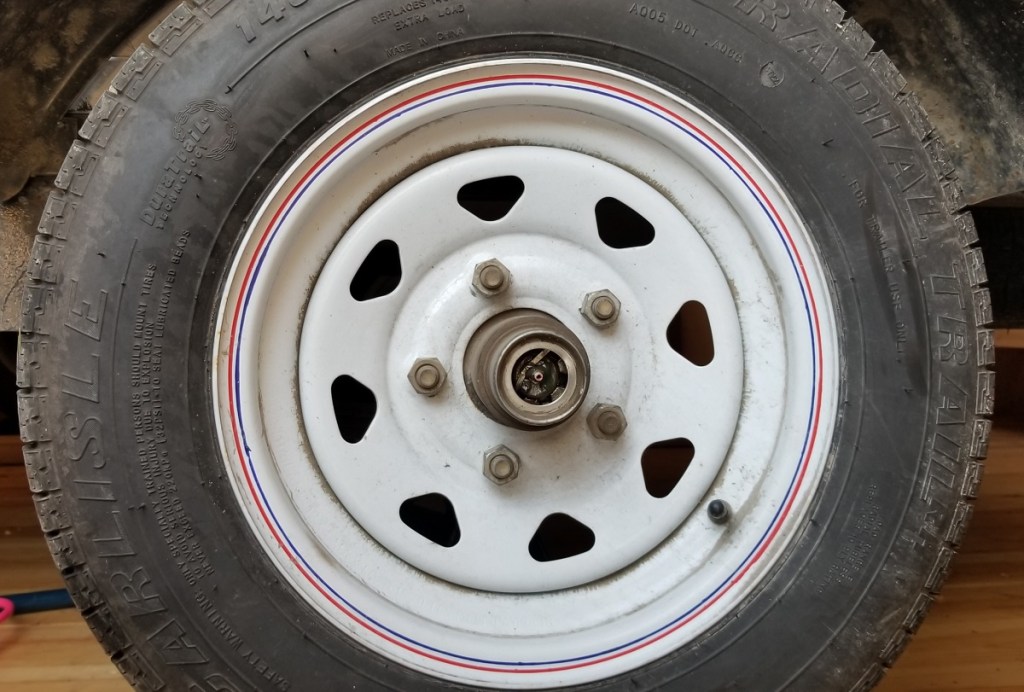
A lot of small trailers like our Teardrop campers come with EZ-Lube hubs, or some variation thereof. The basic concept is that the centre of the hub has a grease fitting (aka grease nipple) underneath the dust plug which allows grease to be pumped deep into the inner workings of the hub.

Search on YouTube and you can find a multitude of videos that, in summary, instruct pumping fresh grease into the centre of the hub whilst rotating the wheel until you see old grease and eventually fresh grease oozing out the gap surrounding the centre. Essentially, new pushes out old.
I’m pretty good with electrical things though less so with mechanical, but this method seemed to make sense and sounded straightforward so I decided to follow it. With a bit of a mess, the job got done simply enough and I figured I had accomplished something useful. However on my next teardrop road trip I noticed lots of grease spatter on the inside faces of each wheel… it seemed that it was escaping from the axle side of the hub and flying around when wheels were in motion.
Too Much of a Good Thing?
I wiped off the wheels to monitor if it was just an initial after-effect of the procedure but it continued to spatter for the duration of my 300-ish km trip. This all seemed worrying, though I’m still unclear if it was actually hazardous. Every time I stopped, I felt the hubs and they never got past lukewarm. I had read of “blowing the seal” on hubs and had visions of all the grease trickling out and causing some sort of catastrophe but, really, with the volume that got pumped in during the procedure the amount spattering out was likely a relatively small proportion.
In any case, I was a bit spooked by all this and seeing as mechanical intuition is not my strong point, I decided to take my teardrop in to the trailer sales+service place in town. They’d been around for quite a few years and had a good rep, both locally and in online reviews. For me, having peace of mind was worth spending the money.
When I picked up my teardrop I had the opportunity to chat with the owner of the trailer place. He was an older guy who seems like he should know a thing or two having run the business for quite some time. The problem with EZ-Lube style hubs, he said, is that they don’t send the grease where it most needs to go—which is into the bearings. And also the volume of grease injected during the method described above really loads up the hubs, which then gets all sloppy and thin as it warms in use and subsequently starts making it’s way out wherever it can, often the rear seal.
Around the same time, my teardrop friend Dave (who I’ve referred to in previous blog posts) sent me this link to a detailed video which included a cutaway hub cross-section that made things more clear. Interestingly, the guy on that video was a trailer service shop owner and remarks that EZ-Lube style hubs result in some of the service visits to his shop. I then found other videos expressing similar views. You know, with zillions of how-to videos on every imaginable topic, uploaded by every imaginable person, the problem is that you’ll find what you’re looking for—whether or not it’s right.

The owner at my local trailer place went on to tell me that you can’t go too wrong putting in a couple pumps of fresh grease at the start of the season. And also EZ-Lube hubs can be useful in an emergency: if the hub feels quite hot, or if you remove the dust plug and the grease looks “fluidy”, something is wrong and fresh grease may get you far enough down the road to somewhere that can help. In either instance, don’t mix grease grades or types; use the same as what is in the hub.
My Conclusions
The only proper way to service bearings, my guy told me, is to disassemble the hub to remove the bearings, clean them, inspect them, and repack them with fresh grease. Even with all the online advice and opinions to be found, probably not many would disagree that this is the best method.
The opinions, however, diverge over how necessary bearing repack is and to what extent alternate methods like EZ-Lube will suffice especially with small, lightweight trailers such as Teardrops. Some say it makes negligible functional difference, while others dismiss methods like EZ-Lube as “country ways”.
If you’ve got basic mechanical know-how, bearing repack is an entirely doable procedure. Personally, I don’t have enough understanding of the workings of mechanical things to assess how adequate various greasing methods are, nor would I feel entirely confident heading out on a road trip long & far having done my own bearings. Call me a fool but I would rather pay someone who does know these things to do it properly. It’s not a lot of money and for me it’s money well spent.
So, that’s how I do things with my Teardrop Trailer but by no means the full story or the best way. What about you? Add your own methods, ideas and experiences using the comment box below for the benefit of all readers.
 Teardrop Trailer Travels