
So, imagine you are camped out with your Teardrop trailer for several days in the middle of nowhere then find your tow vehicle battery has drained and can’t start the engine. Assuming you have an on-board power system, what are some options to get you moving?
I started wondering about this scenario last autumn when, after almost a week at Pukaskwa National Park on Lake Superior (it was so awesome I extended my stay!), I got the Teardrop all packed up to go then had a rude surprise when I pressed the car start button.
In that case, no big problem, there were others in the campground so just a matter of asking someone if they would give me a boost. But I was recalling a primo boondock spot I found the previous year… off the beaten path, barely a handful or two of vehicles passing by each day, and zero cell service… and wondering: if I was out there what would I do?
Prevention Easier than Cure
Before we get to solutions, let’s look at why this happened. In my case, I underestimated how much power vehicle dome lights use over time… in particular the one on the rear liftgate, which is open a fair bit… plus I guess also daily opening and closing of car windows, and other related actions which niggle away at the battery.

That and my Teardropping style, which is once I set-up camp somewhere I’m not that fond of driving. If at all possible, I like to leave the car in place and walk/hike everywhere from there. That being the case, the easiest “ounce of prevention” to avoid needing a “pound of cure” would be to run the car for 5-10 minutes every day or two. I suppose I might also consider switching out incandescent interior vehicle bulbs with LEDs which consume about 90% less power.
But let’s say even if you did run your vehicle regularly (or you’re stubborn like me and refuse to) but inadvertently left something in the ON position, and battery power has diminished to the point in won’t turn over the engine. What now?
Recharge the Vehicle Battery
If you have a solar panel on (i.e., roof-mounted) or with (e.g., portable/folding) your Teardrop camper you could use it to recharge the vehicle battery. Though this may take some time—like a day or more depending on sun conditions—with the 100-150 watt solar panels commonly used with tiny trailers. What’s more, if you’re going to be in place for another day or two, it may be a good idea to ensure the trailer battery(s) get a full charge before disconnecting it from the charge controller while the vehicle battery is recharging.
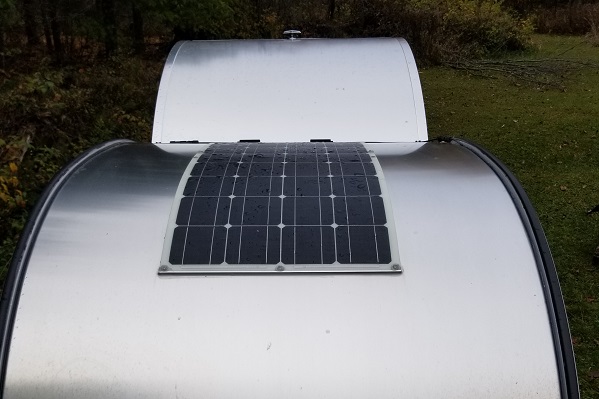
The battery used in your Teardrop trailer power system is likely some type of deep-cycle lead-acid, or a lithium battery. In either case, settings on your charge controller should be changed to reflect the charging profile for your vehicle battery. Those would be useful specs to determine in advance and have on hand—perhaps write them in the back of the car Owner’s Manual.
Unless you have long cables to lead out from the charge controller, you would need to remove the battery from your vehicle; though it’s probably a good idea to disconnect the battery from the car anyhow so that charge is going fully to the battery and not sipped away by background demand from vehicle electronics, etc.
Boost Vehicle from the Trailer Battery
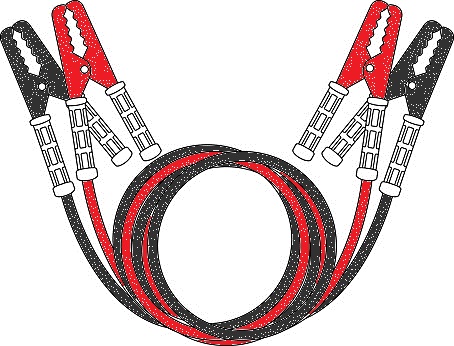
But say you need to get on the move sooner than later, and don’t want to wait around to recharge your vehicle battery… is it possible to boost, aka “jump start”, the vehicle using your trailer battery?
Conceptually, I figured it should work. But I was missing a few details, nor did I have in-depth understanding of battery behaviour. So I got in touch with my solar guy, Greg, who operates Sunfish Solar, which has been around my area for years and well-respected. I entrusted Greg to redesign & rebuild my home off-grid system after a lightning strike on the wind turbine 10 years ago, and five years ago I had him replace my original battery bank and add another solar array. There’s nobody I know with as much expertise and “intuition” on batteries and charging.
Greg’s thought was that, in general, it should work—assuming the trailer battery has sufficient charge to crank the engine for however many seconds it might take to get it started, and that your booster cables are thick enough to carry the required current. How might you assess whether your trailer battery could do it? A starting point is calculating battery capacity (see formulas in next section).
My two trailer batteries theoretically store a total of 1.874 kwH fully charged. The car battery, for comparison, stores 0.468 kwH. Of course, the car doesn’t use up all that capacity every time it starts the engine. In general, in temperate weather, a vehicle starter might draw 150-250 amps from the battery, ideally just for a few seconds until the engine starts. For example, if the starter uses 200 amps for 10 seconds do the math and that works out to 0.007 kwH.
So, relative to the capacity of the trailer battery, it’s not an enormous withdrawal from the account balance, so to speak. But the battery must be able to readily deliver a lot of amps for that brief period of time…sort of like wanting your bank withdrawal in $1000 bills rather than 20s. Greg says deep-cycle lead-acid batteries, though not engineered as “starting” batteries, should nevertheless be able to deliver those amps.

I wondered if, in addition to amps being drawn by the starter, the discharged vehicle battery would also be sucking power from the trailer battery because of the voltage differential between them. Greg confirmed it would but, due to the nature of lead-acid batteries, it would not be taking a substantial amount during the brief time they would be connected to each other.
If your trailer has a lithium trailer battery… though you may boast having more capacity than your Teardrop friends with lead-acid… they usually have electronics in between the battery cells and the terminals so it will depend whether it is programmed to allow such an amp surge. The battery might consider it a fault condition and shut off flow.
In any case, an important caution when jump-starting is that before connecting the trailer battery to your vehicle, you should disconnect anything on your trailer (e.g., charge controller, inverter, etc) from the battery. Or if you have an isolator switch, flip that first. Then connect booster cables just as if it were from another vehicle.
Calculating Battery Capacity
In order to assess and compare battery capacities, you want to be using the same units, so let’s look at ways to calculate capacity it in kwH*:
- If you know the aH (a common rating on deep-cycle batteries) multiply it by 12.5 (average charged-up voltage) then divide by 1000. Example: 75aH = (75 X 12.5) / 1000 = 0.937 kwH
- If you know the “reserve capacity” in minutes @25A (a common rating on vehicle batteries), divide that by 60 then multiply by 25 (amps) then multiply by 12.5 (voltage, as above) then divide by 1000. Example: 90 minute reserve at 25A = (90/60) X 25 X 12.5 / 1000 = 0.469 kwH
Keep in mind the capacities you calculate are theoretical and represent a perfect-world scenario, with battery completely charged and essentially new never having undergone a discharge-recharge cycle. The actual usable capacity will depend on several factors, most notably battery age (or more specifically how many recharge cycles) and temperature.
(* one kilowatt-Hour means 1000 watts of power being consumed by a load, or drawn out of a battery, constantly for one hour)
A Simple Backup
Fascinating as I’m sure this exploration has been, Greg mentioned a far simpler way to insure oneself against a dead vehicle battery… not just when away Teardropping but anytime… and that is to purchase a lithium battery boost box. Maybe $100-150 for a decent one and only about the size of a small box of granola. Rescue yourself, or anyone else, quickly and with minimal hassle.
Hints & Hacks
- When teardropping, carry the tools required to disconnect battery terminals from clamps/lugs, and to remove batteries from the vehicle or trailer if required.
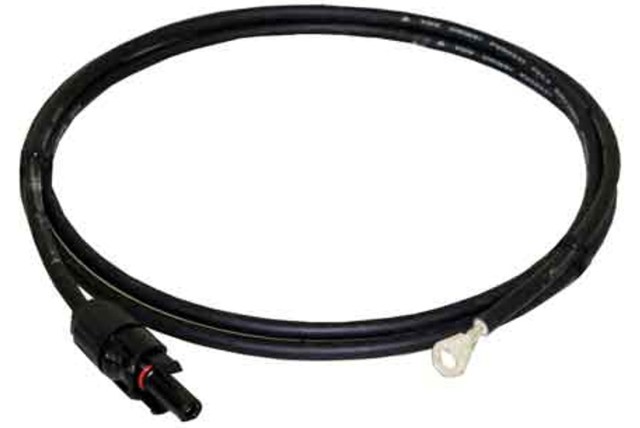
- Consider purchasing or making a couple short cables that have a solar (MC4) connector on one end and a lug on the other. This allows you to easily adapt existing cables for charging or alternative outputs.
- Carry long enough booster cables to reach from trailer battery to car battery. And thick enough too (Greg suggests #4 gauge wire up to 15 ft) to safely carry those high amps.
- Batteries are usually also rated for “Cranking Amps”, which is the amount of current it can deliver for 30 seconds while maintaining a minimum voltage of 7.2 at a temperature of 0ºC. Cold Cranking Amps is the same but at -18 ºC (0ºF).
So, that’s how I do things with my Teardrop Trailer but by no means the full story or the best way. What about you? Add your own methods, ideas and experiences using the comment box below for the benefit of all readers.
 Teardrop Trailer Travels