
Without an inverter in your solar-powered Teardrop trailer, you can only operate things which use 12 volts DC from your battery. An inverter steps up the voltage to 120 and changes it from DC to AC so that you have “house current” in your trailer and can plug in some similar types of things you might plug in at home.
It may be useful to review the electrical system overview to see how all the components fit together.
Trailer Inverter Sizing
There are small inverters which plug directly into a 12VDC outlet (what used to be called a cigarette lighter socket) which tend to supply smaller AC loads around 150 watts or less. Most inverters, however, are hard-wired to the batteries, many of them capable of supplying loads of 1000 watts or more. Hard-wired inverters also have features like low battery cut-off (LBCO), which puts a stop to things if battery voltage gets too low, USB charging ports, and remote on/off or Bluetooth smart linking.
Each inverter will have a rating for the peak and sustained load it can supply. Sustained load is the total amount of watts being consumed by whatever devices, appliances, lights, etc. are drawing power from it. Peak load is what the inverter can temporarily supply, like when you turn something on and it has a brief spike of power required to get it started.
When sizing an inverter to your system, think about what kinds of loads might be simultaneously in operation, total that wattage, and add a safety buffer (like 20%). As a general rule, allow for twice the total operating wattage as peak wattage.
Inverter Sine Wave
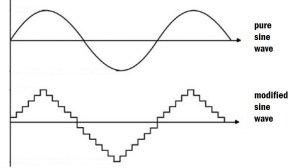
Most inverters are modified sine wave, while a few of the more pricey ones are pure sine wave. This is referring to the “shape” of the electricity frequency. The technical part is beyond my capacity to explain, and largely irrelevant to this topic, other than to say there are a few things which require pure sine wave to operate properly. An example would be a CPAP machine, if you use that at night. Some sensitive electronics and motorized devices may also require pure sine wave… check the manuals. But, in general, most appliances, devices and such are fine with modified sine wave. So far, I haven’t found anything not to work properly with a modified sine wave inverter.
Distributing AC Electricity in Your Trailer
An inverter will have one or more standard 3-conductor electrical outlets like what you have in your house. You need to get the power from the inverter to wherever you will be using it. A low-tech solution is simply to string an extension cord (properly sized for the length of cord relative to load size). Or, more finessed, is to hard-wire into the trailer. Given the Teardrop’s small size, this is often accomplished with a power bar that has a long cord. Easier (and probably more watertight for any drilled holes) is to have it added when the trailer is manufactured.
Reality Check
In addition to sizing an inverter based on your expected loads, it might also be useful to consider the amount of battery capacity you have. If you’ve got one 75 amp-Hour battery, which we assume has in reality about 60 amp-Hours to offer, that means you’ve got about (remember, watts=amps X volts) 60×12=720 watt-Hours until the battery is pretty much depleted.
But because you read my sage advice on extending battery life by avoiding letting it get below 50% state-of-charge, at least not often, you’re going to reduce that 720 watt-Hours to, say, about 400 as you estimate how much power is “in the bank” so to speak. So, in practical terms, you could operate something that uses 400 watts for a total of one hour, or something that uses 800 watts for ½ hour, and so on, before you better not use any more for the sake of the battery.
So, yes, you can use an inverter to power a toaster (800-1500 watts) or a compact microwave (800-1100 watts) or your favourite “bullet” blender (~600 watts) but that doesn’t mean it’s necessarily a good idea. And, though you can get a 3000 watt inverter, are you ever going be using that kind of power all at once? If you are, it won’t be for very long, especially with a single battery.
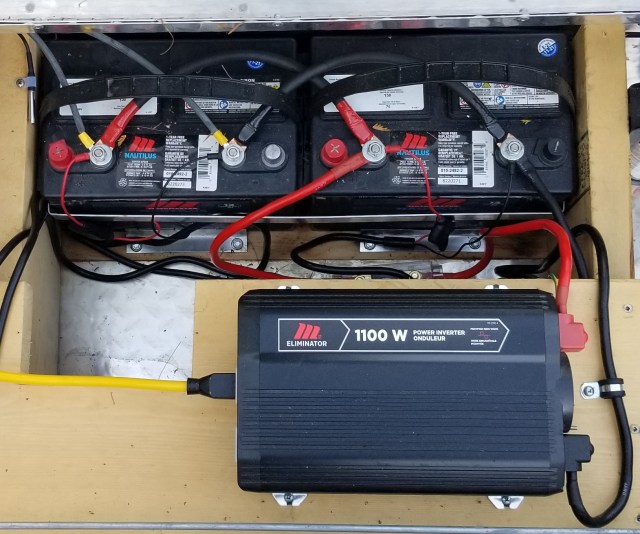
Personally, I have a 1100 watt (2200 peak) inverter in my Teardrop, though I am rarely using anything(s) that draws more than 400 watts at once. A larger inverter would waste space and, since there is a tiny “overhead” power draw anytime it is turned on, it would also use up a bit more of my battery capacity just by sitting there at the ready.
Hints & Hacks
- Search the vast world of online commerce for down-sized versions of appliances which use fewer watts. See my posts about the tiny kettle or the mini rice cooker.
- It is more efficient to use 12VDC direct from the batteries when possible. For example, use device chargers which plug into a 12V automotive outlet. Otherwise, the inverter is changing DC into AC house current but the charger you plug into AC is then changing it back into DC to charge your device.
- Be mindful of phantom load. If anything plugged in generates any type of light or feels warm, it is drawing power whether it’s “doing something” or not. Also, whenever you have no need for house current, turn off the inverter.
So, that’s how I do things with my Teardrop Trailer but by no means the full story or the best way. What about you? Add your own methods, ideas and experiences using the comment box below for the benefit of all readers.
 Teardrop Trailer Travels
Excellent information about inverters. I am in the initial stages of outfitting my recently purchased teardrop shell, but I believe I will go with a 600 watt pure sine inverter. It is inexpensive, small and light weight. The largest load will probably be my 400 watt rice cooker.
LikeLike