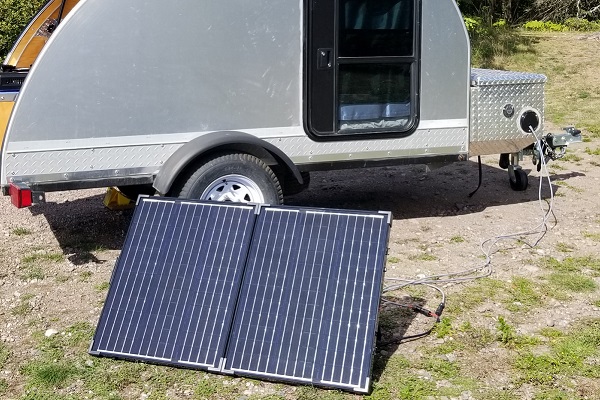
I mentioned in Teardrop Trailer Buying Advice that I would have rather had a higher wattage solar panel on the roof of my Teardrop camper than what was supplied with it. But last autumn I made an addition to the power system that was simple, relatively inexpensive, and quite effective.
Before getting to describing the solution, let’s first look at the problem: the batteries, the solar panel, and why it was incapable of properly charging them.
Batteries: The Bank Account
The power system on my Teardrop Trailer has two 75 amp-hour deep cycle 12 volt batteries. That means each battery has a capacity of 75×12=900 watt-hours, and thus the power storage capacity of my two-battery system is 1800 watt-hours. (more on batteries, capacity and watt-hours in a previous blog post)

Of course, 1800 watt-hours capacity is a theoretical number which assumes that the battery is brand new, completely charged, and discharged all the way down to nothing, under perfect conditions and with no losses. In reality, a battery loses capacity with repeated charge cycles so mine are no longer a full 900 watt-hours each. And, for good battery health, I never run them all the way down… so whatever their capacity actually is… I don’t have all of that to use.
For the sake of an example, let’s say my battery has lost 10% of its capacity since new and therefore when fully charged has about 810 watt-hours. Now, I’m making an educated guess at this, but let’s also say that I don’t let it go down any more than 60% depth-of-discharge (DoD), which means the battery would have 324 watt-hours (40% of 810) remaining at that point.
So, it’s theoretical and ignoring losses and inefficiencies inherent in any rechargeable battery system (plus other factors I don’t honestly understand enough to fold into the calculation but are likely minor), but using the example above an approximate amount of power “withdrawn from the bank” so-to-speak when my batteries are down to 60% DOD so would be 810-324=486 watt-hours, per battery.
Solar Panel: The Income Earner
The flexible panel on my Teardrop roof is “100 watts”, though even in bright sunny conditions I have never seen the charge controller register wattage higher than the mid-80s. That peak wattage output comes around the middle of the day when the sun is directly overhead and is, of course, lower during the hours preceding and following the mid-day period.

Again I am making general guesses at numbers for the sake of example, but let’s say that the flexible rooftop panel is indeed putting out 80 watts for the 3 hours around midday and that this amount on average reduces by 15 watts each hour preceding and following that 3 hour period. So the average watt production each hour would look something like: 20 35 50 65 80 80 80 65 50 35 20
Now, that is assuming a perfectly cloudless day, the panel right out in the open with no trees or other horizon obstructions and, what’s more, an 11-hour charging day. I know, not too likely heh! Well, not here in Canada anyhow. But play along with me here for the example. If you add up the incoming power to the charger it would total 520 watt-hours. Again, we’re not counting in losses and inefficiencies but do understand that not all of that 520 watt-hours produced is actually getting “deposited into the bank”.
Running a Deficit
If you’ve been following along, and even with the numbers and calculations in this example being highly simplified, you are likely seeing the issue with my Teardrop power system as originally equipped. If my two-battery system has got down to 60% DOD… which is quite possible after several days of off-grid Teardropping… then 486×2=972 watt-hours (and then some, accounting for overhead) need to go back into the batteries to get back to full.
But that “100 watt” flexible panel on the roof can only give me 520 watt-hours of power in perfect (and impossible!) charging day. It doesn’t have enough oomph to properly charge my two-battery system. In fact, it is only just barely adequate for a one-battery system.
The battery “bank account” begins running a deficit, with more going out than coming in each day, and the balance gradually (or quickly if there’s a string of grey days) declines. Except with batteries there’s no overdraft on this account. And, even with deep cycle batteries, taking them down too low, too many times, will have a noticeable effect on useful lifespan as measured in recharge cycles.
Solution: Auxiliary Solar Panel
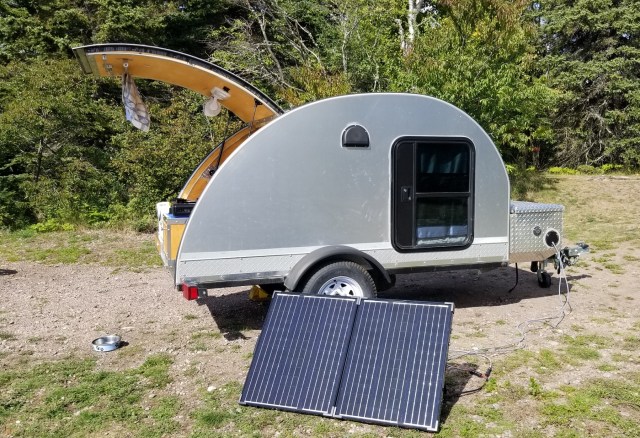
The solution, at least a partial one, to this “underfunding” was adding a portable solar panel to the system. Essentially two rigid monocrystalline panels hinged together, a portable panel has considerably higher efficiency than a flexible one, along with an adjustable tilt angle.
Being portable, you can situate it in a spot which gets the best exposure, and the longest solar day. And, if you’re around at your site, it can be moved occasionally as the sun travels its arc through the sky such that it hits the panels as closely as possible to 90 degrees (especially helpful in spring and fall when the sun is less “overhead”). My portable panel is rated 100 watts but in peak conditions and the panel facing directly to the sun I have seen it sending almost 120 watts to the charge controller–and that was in September.
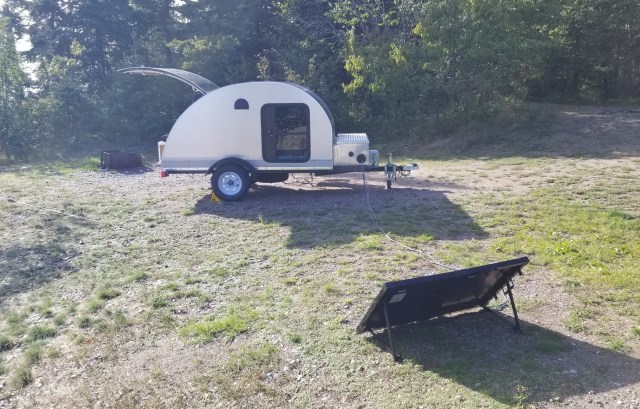
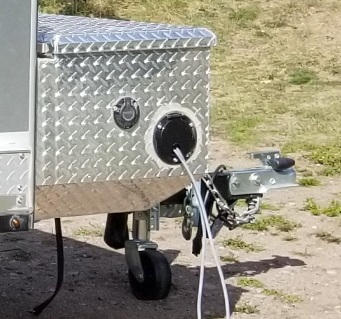
Unfortunately, because the output specs are different for the flexible and portable panels they cannot both be connected to input to the charge controller at the same time. I have to switch them out, which is easy using the MC4 solar wiring connectors. I could add a second identical portable panel and use a branch connector to join them together. But that’s another thing to take up space in the car, and add complexity and clutter at the camp site. In hindsight, perhaps I should have got a 200 watt portable panel but didn’t feel I wanted to give up that space and money.
In any case, even just the single 100 watt portable panel produces significantly more power than the flexible panel and helps me stay “off-grid” Teardropping for longer. More often than not, the flexible panel was unable to supply enough power to complete the Bulk charging stage, but with the portable panel most days it completes Bulk and sometimes even the Absorption charging stage. Another piece of a solution would be to do an occasional overnight at site with electrical hookup and use the on-board charger to push the batteries up to complete and full charge every week or so.
All this is to say that for your Teardrop trailer solar power system to function well, especially if you will be off-grid teardrop camping, it’s helpful to figure out the numbers, even if you’re just making approximations like I have done here. BTW, if you’re an engineer, whether professional or just by nature, please try to resist the urge to write in and niggle over the details I have no doubt missed in my estimates and calculations 😉 My point was just to show in a general way the relationship between solar power inputs and battery outputs and how they should be compatibly sized.
So, that’s how I do things with my Teardrop Trailer but by no means the full story or the best way. What about you? Add your own methods, ideas and experiences using the comment box below for the benefit of all readers.
 Teardrop Trailer Travels
Nicely said, having a very similar set-up to yours I agree with everyting. Since the wet cells in reality only have half their capacity as useable before damage to the battery, I wrecked one, I paid the price (literally) and switched to lithium, one on board and the other a portable package, a Jackery. A 1000 watt lithium can give up to 1000 useable watts though I only take them down to 20%. Since so many campsites are often shaded even with extension cords connected to the panels, I can walk the Jackery and it’s portable solar panel to a really sunny spot and keep it topped up and let the on board keep the refridgerator cooling, then switch back to the portable reducing total draw to the on board. Thanks for posting, keeps me thinking better weather is coming, I have already booked into Killbear Park the first week of May.
LikeLike
Yes, this seems to be the time of year we (here in Canada & the northern states) begin looking forward to getting back out in our Teardrops!! It was in late January last year I began work on the teardroptrailertravels.ca blog and though it was mainly about creating a web site with lots of useful, practical information for Teardroppers like us, creating it had the side benefit of being a great winter diversion that had me going back though nice pics and great experiences from the previous two teardrop camper seasons 🙂
LikeLike
And thanks for your feedback on the topic Dave. Your power system setup is a unique hybrid, part on-board and part-portable which seems to offer max flexibility. I would love to profile your system in an upcoming blog post and will get in touch directly by email about that.
LikeLike